Spring 2026
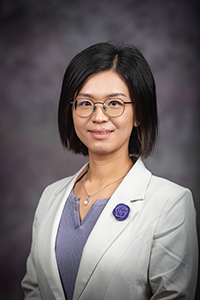 Dear Alumni and Friends,
As we conclude the Spring 2026 semester, I am proud to reflect on another exciting season of growth and achievement in the Event and Hospitality Management program at Kansas State University. This semester, our students and faculty continued to demonstrate the innovation, experiential learning, and industry engagement that define our program.
Our students gained valuable hands-on experience through facility management field trips, secret shopper projects, conference participation, and research presentations. This spring, students presented their research at the annual HHS Research, Scholarly and Creative Activities, and Design (RSCAD) Forum, the Graduate Student Conference at Auburn University, and the International Council on Hotel, Restaurant, and Institutional Education (ICHRIE) Eta Sigma Delta Undergraduate Research Symposium in Boston. Students also attended the Club Management Association of America (CMAA) National Student Education Conference, the CMAA World Conference and the National Restaurant Show, expanding their industry knowledge and professional networks. We are especially proud to celebrate Lili McCallum (EHM Junior)’s Meritorious Paper Award and Erin Gleason (EHM PhD student)’s Outstanding Graduate Student Award.
One of the highlights of the semester was the 29th Annual Travel and Dining Auction, our signature student-led fundraising event, which raised scholarship support for Event and Hospitality Management students. The event showcased the incredible dedication, professionalism, and teamwork of our students and faculty, while continuing a long-standing tradition that directly impacts student success.
We also continue advancing innovation in hospitality education. At Lacy’s, integrating robotics technology and event and catering management software into operations has enhanced both student learning and operational efficiency. Faculty members remained highly active in research and industry engagement, producing nine journal publications, 17 conference presentations, and securing grant funding to support interdisciplinary teaching and research initiatives.
Most importantly, we are deeply grateful for the continued support of our alumni, advisory board members, donors, and industry partners. Your mentorship, encouragement, and generosity create meaningful opportunities for our students and strengthen the future of our program.
Thank you for being part of the K-State Event and Hospitality Management community. We look forward to continuing this exciting journey together.
Warm regards,
Dr. Cece Leung
Program Chair, Event and Hospitality Management
Kansas State University
Student Experiential Learning Highlights: Learning by Doing the Real Work
Spring 2026 was a semester where students spent less time talking about hospitality and events and more time doing the work itself. Across EHM courses, students worked with real clients, real guests, real deadlines, and real operational challenges that pushed them to think, adapt, communicate, and lead in ways that cannot be fully replicated in a traditional classroom.
College of Health and Human Sciences RSCAD
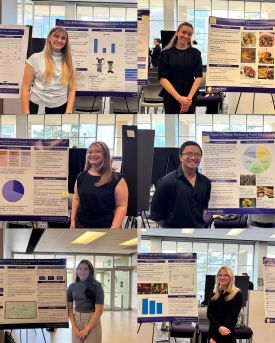
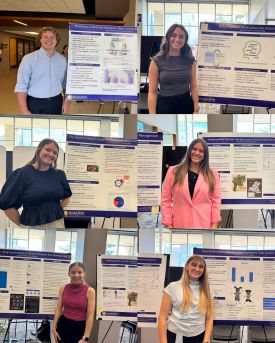
One of the clearest examples of this growth came through undergraduate research. What began in HM 303 Operational Research classroom discussions developed into a record-breaking showing at the CHHS RSCAD Forum and University Undergraduate Research Symposia, where 17 undergraduate students presented their work. Among them, Lili McCallum received the Best Presenter Award for her professionalism and presentation skills.
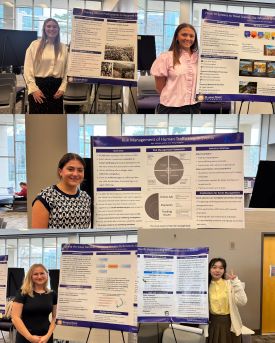
International Council of Hotel, Restaurant, and Institutional Education Eta Sigma Delta Undergraduate Research Symposium
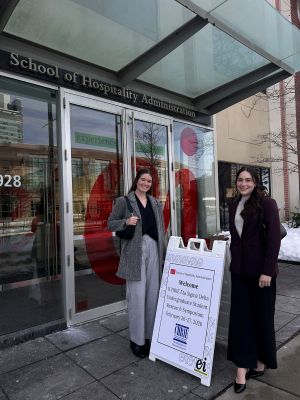
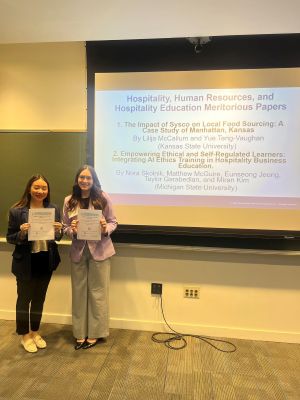
For Abby Fleischer and Lili McCallum, the experience continued far beyond campus as they traveled to Boston to represent K-State at the International Council on Hotel, Restaurant, and Institutional Education (ICHRIE) Eta Sigma Delta Undergraduate Research Symposium. Abby presented research examining how youth sports tourism contributes to local economic development and community growth in Westfield, Indiana. Her work later gained additional recognition through a featured appearance on a youth sports tourism podcast. Lili’s research explored how large food distributors influence local sourcing practices within hospitality operations in Manhattan, Kansas. Her project earned the prestigious Meritorious Paper Award, bringing national recognition to both her work and the EHM program.
Club Management Association of America World Conference
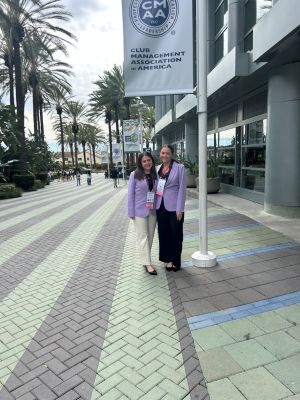
EHM students Sophia Struck and Josephine (Jojo) Valdivia represented K-State this spring at the Club Management Association of America (CMAA) World Conference in Anaheim. Through conversations with club managers, executives, and hospitality professionals, they gained a closer look at the relationship-driven nature of private club management and the leadership skills required to create high-touch guest experiences.
Mystery Shopping
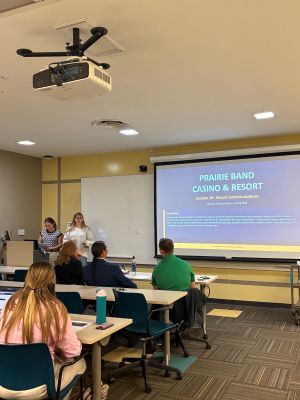
In HM 321 Hospitality Service Systems class, students stepped into the role of mystery shoppers at Prairie Band Casino and Resort and Lacy’s. They evaluated arrival experiences, communication, atmosphere, service recovery, and operational consistency, then presented their findings directly to Prairie Band leadership. The assignment challenged students to move beyond observation and translate their experiences into feedback that professionals could actually use.
Simulated Hotel Operation
Students in HM 361 Hotel Operations class managed simulated hotel properties throughout the semester, making decisions related to operations, staffing, competition, and changing market conditions. Working in teams, they learned quickly that hospitality decisions rarely happen in isolation and that every operational choice affects both guest experience and business performance.
Facilities Management
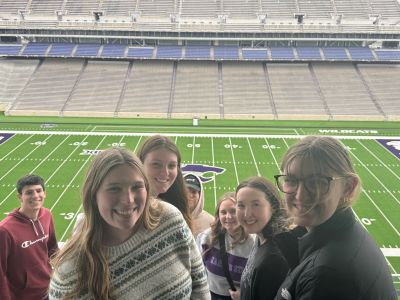
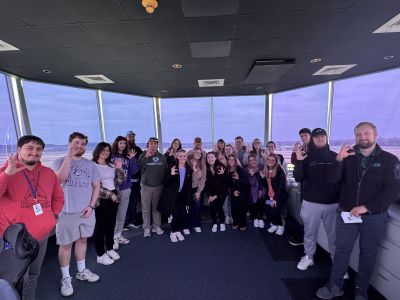
HM 423 Facility Management class took students into hospitality operations across the region through visits to Bluemont Hotel, Manhattan Regional Airport, Bill Snyder Family Stadium, and DoubleTree by Hilton Manhattan. Walking through these facilities with industry professionals gave students a closer look at the behind-the-scenes coordination required to manage large hospitality and event environments.
Event Coordination Techniques
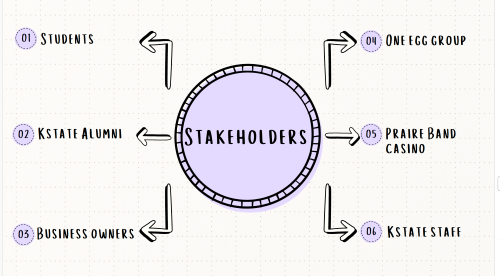
In HM 463 Business Event Coordination class, students used the Event Design Canvas to rethink how events are planned. Rather than focusing only on logistics, students were asked to consider what guests value, what they fear, and what should change because of the event experience itself. Along the way, students earned recognition as YP Event Designers and developed a shared design language they can carry into future internships and careers.
Lubbock Arts Festival
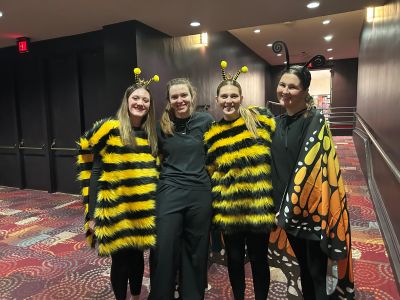
Another group of students traveled to the Lubbock Arts Festival to evaluate the event from a different perspective: as volunteers. Going undercover within the volunteer program, students observed communication, supervision, role clarity, appreciation, and operational support systems while experiencing firsthand how much events depend on volunteers working behind the scenes.
"Undercover Prof"
Meanwhile, students in HM 650 Senior Seminar created “Undercover Prof,” a project designed to make the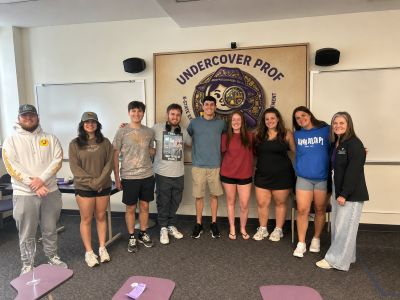 transition from college to career feel more honest and less mysterious. Student teams interviewed professionals across hospitality, tourism, sales, leadership, and operations, including representatives from Hilton Garden Inn, Xanterra Travel Collection, Champion Ranch, and event management companies. The conversations focused less on polished success stories and more on the realities of entering the industry: unexpected career paths, difficult first jobs, leadership lessons, and the skills professionals wished they had developed earlier.
Taken together, these experiences reflect what hospitality and event education looks like when students are trusted with meaningful work. They researched, presented, evaluated, interviewed, planned, observed, solved problems, and communicated with professionals in real time. Sometimes it was messy. Sometimes it was challenging. But it gave students a much clearer understanding of the industries they are preparing to enter.
2026 Travel and Dining Auction
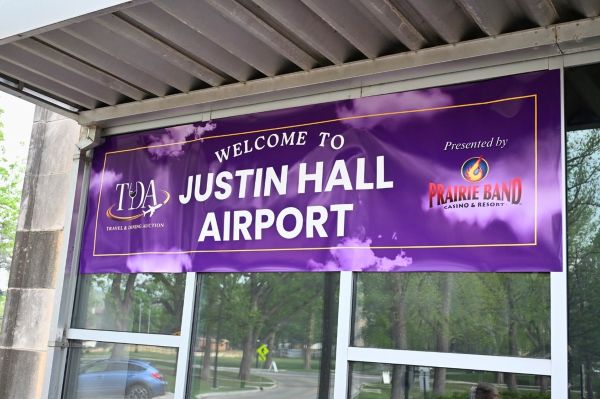
The 2026 Travel and Dining Auction came home to Justin Hall this year, and it just felt right. Moving back gave the evening a more intimate, connected, and slightly “we know where the extension cords are hidden” kind of energy. Justin Hall was transferred to a terminal for The Golden Age of Travel. What is normally an academic building became an event environment with airport-inspired guest moments, flight attendants, pilots, globes, maps, baggage claim, duty-free shop, auction areas, themed signage, and travel details throughout the space.
This course is one of the hardest things Ms. Cindy Lerick teaches. Not because students are not capable, but because experiential learning is beautifully messy and chaotic. There is no textbook chapter that fully prepares you for auction items, table layouts, donor questions, last-minute changes, sponsor expectations, student nerves, and the occasional “wait, who has the signage?” moment...
The challenge, as the instructor, is knowing when to step in, when to step back, and when to stand quietly in the corner, pretending not to panic. Students have to be given enough room to lead, make decisions,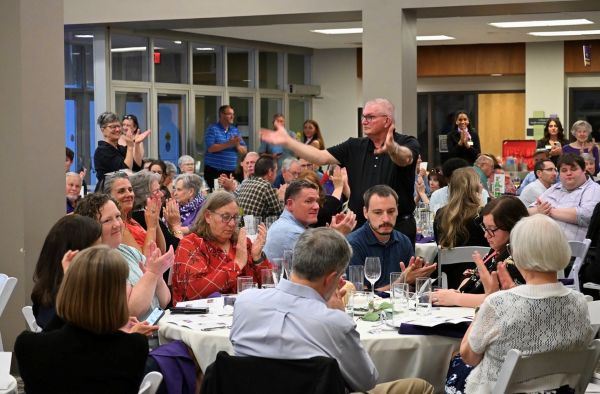 solve problems, and occasionally discover that “we’ll figure it out” is not actually a production plan.
And they did figure it out.
This year’s students created an evening that was warm, welcoming, and full of hospitality. They learned that events are not just about pretty tables and good food. They are about communication, timing, teamwork, flexibility, and caring enough to get the details right.
The outcome was more than a successful auction. It was a real-world learning experience, a fundraiser for future experiential learning, and a reminder that when students are trusted with meaningful work, they can absolutely rise to the occasion.
Graduate Student Research: Erin Gleason
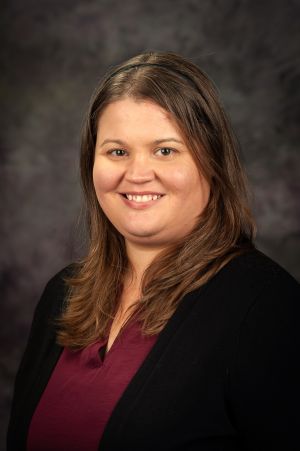
Erin Gleason’s dissertation research focuses on an often-overlooked area of hospitality management: foodservice operations in senior living and healthcare facilities. Her work explores how foodservice employees understand and respond to the risks associated with texture-modified foods, which are specially prepared meals and beverages designed for individuals with swallowing disorders. These modifications can include chopping, pureeing, or thickening foods to make them safer to consume. When done incorrectly, however, the consequences can be serious, including choking, aspiration pneumonia, malnutrition, and declining quality of life for vulnerable older adults...
Drawing from her professional experience working in hospitals and senior living facilities, Erin’s research highlights an important challenge within healthcare foodservice operations: while employees are often trained on the technical process of preparing modified foods, they may not always fully understand why these modifications are critical to resident safety and well-being. Her work examines how improving employees’ understanding of these risks may influence food preparation behaviors and ultimately improve care for residents in long-term care settings.
As the aging population continues to grow, Erin’s research addresses an increasingly important issue at the intersection of hospitality, healthcare, and nutrition. Her work contributes to a growing need for more research focused on foodservice employees in healthcare environments and offers practical insight into improving training practices within senior living operations.
In addition to teaching the Lacy’s Commercial Food Management course, Erin was recognized this year with both the Outstanding Graduate Student Award and the Myers-Alford Teaching Award for the 2025–2026 academic year.
Alumni Highlight: Ethan Rice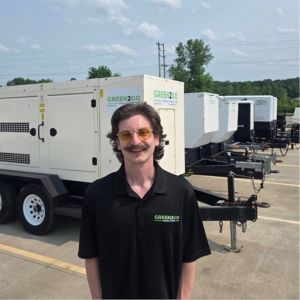
With a unique background spanning personal financial planning and construction management, Ethan brought a diverse skill set into the hospitality field, combining financial awareness, operational logistics, and technical understanding of infrastructure. This interdisciplinary foundation positioned him to thrive in the complex world of large-scale event production.
In 2024, Ethan participated in a faculty-led trip to the Saint Louis Art Fair, where he gained behind-the-scenes exposure to festival operations. During that experience, he connected with Chuck Justus, founder of Green2Go Rental Power, an encounter that would shape his career trajectory.
Motivated by that experience and faculty mentorship, Ethan took the initiative to pursue an opportunity with Green2Go. Just one year later, Ethan played a critical role in powering the 2025 Saint Louis Art Fair, an event featuring three days of programming, three performance stages, 20+ live performances, 25 restaurants, 220 artists, and approximately 150,000 attendees
From managing nearly a mile of cable to coordinating real-time communications across teams, Ethan helped ensure the seamless execution of a complex, high-impact event.
Ethan’s story highlights an important reality: hospitality and event management are not isolated fields; they are integrative platforms that connect business, construction, logistics, finance, and technology. His success demonstrates how students with diverse academic and professional backgrounds can find meaningful and impactful careers through hospitality education.
Closing Thoughts
This spring reminded us what hospitality and event education looks like when students are trusted with real work. From presenting research and managing live events to working directly with industry professionals, our students continued to step into leadership roles, solve problems in real time, and represent K-State EHM with professionalism, creativity, and confidence. None of this would be possible without the support of our faculty, alumni, advisory board members, donors, and industry partners who continue investing their time, mentorship, and opportunities into our students and program.
As we continue building the future of Event and Hospitality Management at K-State, your support directly helps create scholarships, experiential learning opportunities, industry experiences, and program innovation for our students. Support our efforts to enhance program marketing, student scholarships, and faculty development by making your donation.
Warm regards,
K-State Event and Hospitality Management Faculty and Students
Is your high schooler starting to explore colleges? Schedule a Campus Visit TODAY...
Prospective students have several opportunities to visit the campus and meet with program representatives. Explore K-State and the Event and Hospitality Management program by scheduling a Campus Visit!
Donate
Support student success by giving to our Hospitality Management Excellence Fund (J36750) through the K-State Foundation. Your gift enhances student events, engagement, scholarship, and facilities. Donate today and make an impact!
Interested in joining the College Professional Mentor program?
Are you interested in mentoring our students? The College of Health and Human Sciences provides a Professional Mentor Program for the students, pairing firm and industry individuals with students wanting a more in-depth understanding of the profession or area they seek to work in. If interested in learning more about being a mentor, please visit the mentor webpage or email the College of Health and Human Sciences Career Development Coordinator.
Do you have a job or internship you want us to share with our students?
If you want to promote an opportunity to our Event and Hospitality Management students for an upcoming summer internship or post-graduation job, please let us know.
Follow Us:
Stay connected and see what's happening in K-State Event and Hospitality Management!
 Instagram
 Facebook