The AT Industry
1. Climate Change and the AT Industry
This section focuses on the relevance of climate change to the apparel and textile industry. It describes how the industry contributes to climate change. The industry is changing in response to climate change. Students have a tremendous opportunity to be agents of change in the apparel and textiles industry.
Climate Change and the AT Industry
As an industry, apparel and textiles is one of the biggest GHG emitters on Earth because of its huge size and global scope. In 2015, the global apparel and textile industry had a total value of nearly 2 trillion US dollars (https://www.slideshare.net/slideshow/state-of-the-apparel-and-footwear-market-in-2015/46324057).
Many processes and products necessary for making fibers, textiles and apparel products consume significant quantities of fossil fuels. As a result, the apparel and textile industry accounts for approximately 10% of total carbon emissions (Zaffalon, 2010).
The following figure illustrates the apparel and textile supply chain with energy and raw material inputs recognized. It also indicates that there are outputs (such as solid and liquid waste and air pollution) at each stage.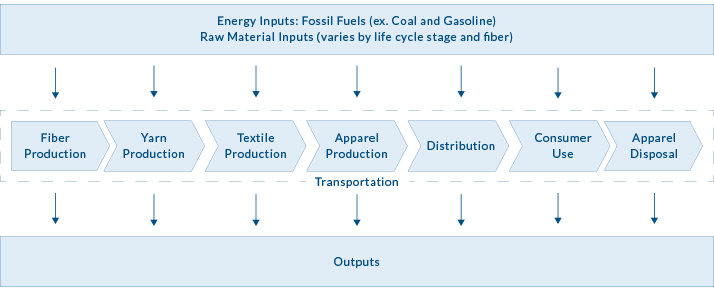
Both the inputs and the outputs relate to climate change because of the GHG emissions associated with energy production and consumption in all stages.
Manufacturing of both textiles and apparel depends heavily on industrial machinery, typically powered through the burning of fossil fuels. Therefore the manufacturing of both textiles and apparel carries high energy demands.
A carbon footprint is the total amount of CO2 and other greenhouse gases (GHGs) emitted over the full life cycle of a process or product. It takes into account energy inputs and emission outputs throughout the whole supply chain from raw materials to processing, transport, final use, and disposal. A carbon footprint is measured by weight and usually reported in either tons or kilograms.
It is estimated that 60 billion kilograms of fabric are produced globally each year. This production requires 1 trillion kilowatt hours of electricity. Every Kilowatt hour of electricity produced by burning coal produces 900 grams of CO2 (Conca, 2012).
Additionally, the global non-profit organization, Business for Social Responsibility (2009) calculated aggregate clothing life cycle greenhouse gas emissions and determined the following:
- Fiber production accounted for 18% of total clothing greenhouse gas emissions
- Spinning accounted for 16%
- Consumer care for 39%
- Other stages along the supply chain accounted for between 1% and 7% each
Focus on the stages of fiber, yarn and textile production
The following figure is similar to the previous figure, however it is more narrowly focusing on the stages of fiber, yarn and textile production.
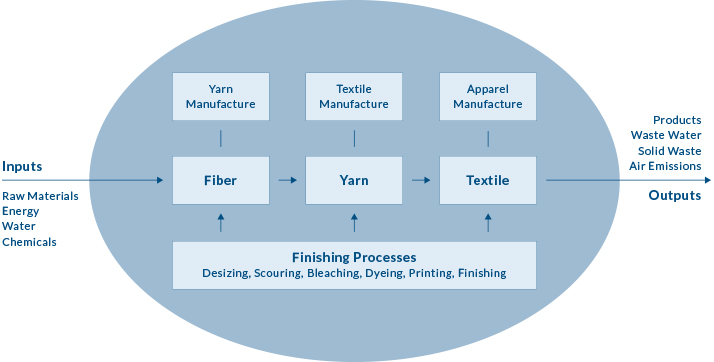
This figure also includes the addition of the wet finishing processes of cleaning, dyeing, printing and finishing fibers, yarns and textiles, all of which are important processes to consider when examining climate change and the AT industry because these are energy intensive processes.
The carbon footprint associated with the spinning, knitting, dyeing, finishing, cutting and sewing required to manufacture 1kg of fabric can reach up to 12.5kg of CO2.
Compare this to the carbon footprint of steel which is about 2kg of CO2 per 1kg of steel (Zaffalon, 2010).
SELECTED Facts to consider regarding the Apparel and textile Industry's Carbon Footprint:
- The primary energy source within the manufacturing of AT remains fossil fuels.
- Many processes and products that go into making of fibers, textiles and apparel products consume significant quantities of fossil fuels.
- Annually the AT industry produces 60 billion kilograms of fabric, which consumes 1 trillion kilowatt hours of electricity (Zaffalon, 2010).
- In 2010 the electricity demands of the AT industry consumed 132 million tons of coal (Siegle, 2011).
- The production and consumption of a 100% cotton tshirt consumes 109MJ of energy in order to grow and process the cotton fibers, manufacture and dye the yarns, knit the textile, construct the tshirt, launder it 25 times, and incinerate it after consumer disposal (Allwood et al., 2006).
- China and India are both among the top textile and apparel manufacturing countries in the world.
- 66% of China’s energy comes from coal and 20% from oil (https://www.eia.gov/international/analysis/country/CHN).
- 55% of India’s energy comes from coal (https://en.wikipedia.org/wiki/Energy_policy_of_India)
- China and India combined are responsible for 54% of global consumption of coal (US Energy Information Administration, 2013 https://www.eia.gov/pressroom/presentations/sieminski_07252013.pdf
Climate Change and the AT Industry
- Forbes Report from United Nations introducing risks and opportunities for business: Climate Change Threatens Economic Growth- How Should Investors React https://www.forbes.com/sites/mikescott/2014/04/03/climate-change-threatens-economic-growth-un-report-how-should-investors-react/
- CBS Money Watch Business leaders say climate change threatens economy https://www.cbsnews.com/news/business-leaders-say-climate-change-threatens-economy/
- Bloomberg Business Which Sectors are most at Risk from Climate Change? http://www.bloomberg.com/news/videos/b/57b8dd7f-d120-4947-8fe8-f48154297c23
- ABC Landline Climate Change and Agriculture http://www.abc.net.au/landline/content/2013/s3682086.htm
- ABC Landline Wool Revival http://www.abc.net.au/landline/content/2015/s4258864.htm
- Climate Change Pledge by leading apparel companies in response to COP21 http://www.ceres.org/files/apparel-statement/at_download/file
References
- Allwood, J.M., Laursen, S.E., de Rodríguez, C.M., & Bocken, N.M.P. (2006). Well dressed? The present and future sustainability of clothing and textiles in the United Kingdom. Cambridge, UK: University of Cambridge, Institute for Manufacturing.
- Business for Social Responsibility. (2009). Apparel industry life cycle: Carbon mapping. [Online] Available: https://www.bsr.org/reports/BSR_Apparel_Supply_Chain_Carbon_Report.pdf
- Conca, J. (2012). How deadly is your kilowatt? We rank the killer energy sources. Forbes Available: https://www.forbes.com/sites/jamesconca/2012/06/10/energys-deathprint-a-price-always-paid/
- Siegle, L. (2011). To die for: Is fashion out of this world? London, UK: Fourth Estate.
- Zaffalon, V. (2010). Climate change, carbon mitigation, and textiles. [Online] Available: http://www.textileworld.com/Issues/2010/July- August/Dyeing_Printing_and_Finishing/Climate_Change-Carbon_Mitigation_And_Textiles
2. AT Industry and Sustainability
The purpose of this section is to describe some of the ways the AT industry is responding to sustainability challenges. For those wanting to contribute to the transition toward sustainability, the AT industry provides diverse opportunities.
AT Industry and Sustainability
Changes the AT Industry is making to reduce environmental impacts
One of the first steps that many manufacturers and retailers in the AT industry have taken is to learn more about the sources of the materials used in their products and then share what they have learned with consumers, an effort towards transparency (Nimon & Beghin, 1999). Conducting a life-cycle analysis of their products revealed that there were certain phases where products and processes had significant environmental impacts (Smith & Barker, 1995). The initial focus was often on the fibers used for products and companies like Patagonia led the transparency movement by switching to organic cotton and then sharing with their customers the rationale behind the change (Chouinard & Brown, 1997). Soon, companies that were already focusing on social responsibility efforts found that being transparent about the sources of materials and the places where their products where manufactured could create a competitive advantage that outweighed the benefits of keeping their sources secret (Porter & Kramer, 2006).
At the same time, researchers were working to develop fiber from materials, such as PLA (Polylactic Acid), that could reduce the environmental impact of fiber production while keeping the properties, such as easy care, that consumers had come to value (Vink et al., 2003).
When lifecycle analyses showed that the consumer use phase of apparel products have the most significant impact on carbon emissions through energy use (Allwood et al., 2015), the AT industry also began working on changing care labels to encourage energy reduction. Marks & Spencer, a major UK retailer, incorporated climate change as one of the major pillars in their pivot towards sustainability and required their suppliers to produce garments that could be labeled as “cold water wash” as well as opening stores that made major improvements in energy use (Bell et al., 2009).
Besides the concern about energy use and its relationship to climate change through carbon emissions, the AT industry depends on water for almost every phase of production, from water for crops to water for laundry (Morrison et al., 2009). Brands like Levi’s have developed innovations in textile processing that reduce water consumption and created educational campaigns to help their customers reduce water use at home (http://store.levi.com/waterless/). DyeCoo, a process of waterless dyeing with reclaimed CO2 uses a closed loop system that produces no waste water and is energy efficient is being used to dye textiles (https://dyecoo.com/co2-dyeing/).
Groups such as the Sustainable Apparel Coalition have formed to share tools created by leaders in the AT industry to improve the ability of designers, producers and retailers to reduce the impact of their products on climate change (https://cascale.org/tools-programs/higg-index-tools/).
AT Industry and Sustainability
- ACTIVITY: Waste Equals Food - Jeopardy (pptx)
-
ACTIVITY: Assign - Chapter 4 "Waste Equals Food" from Cradle to Cradle: Remaking the Way We Make Things
McDonough, W. & Braungart, M. (2002). Cradle to Cradle: Rethinking the Way We Make Things. New York: North Point Press.
View video listed in More Information and Resources: WeWantToLearn.Net Waste = Food (Cradle to Cradle) (49:19 minutes)
- ACTIVITY: Waste Equals Food Lecture Slides (pptx)
- AT Industry and Sustainability - PowerPoint Presentation (pptx)
AT Industry and Sustainability
- WeWantToLearn.Net Waste = Food (Cradle to Cradle) (49:19 minutes) https://wewanttolearn.wordpress.com/2012/04/16/waste-food-cradle-to-cradle/
- On this page A Business Leading on Sustainability about Interface Carpet (5:17 minutes) http://sustainabilityhub.com/newvideos/
- V&A joint fashion and climate change hackathon https://www.youtube.com/watch?v=5A_sKZvoV0o
- TED Talk Changing the World Through Fashion: Eva Kruse https://www.youtube.com/watch?v=d4VTPLpfGq0
- Nicole Bridger: Sustainable Fashion https://www.youtube.com/watch?v=mak8FqhnPKM
References
- Allwood, J.M., Laursen, S.E., de Rodríguez, C.M., & Bocken, N.M.P. (2015). Well dressed?: The present and future sustainability of clothing and textiles in the United Kingdom, 42. Available: https://www.ifm.eng.cam.ac.uk/insights/sustainability/well-dressed/
- Bell, D.E., Nitin S., & Winig, L. Marks and Spencer: Plan A. Harvard Business School Case 509-029, January 2009. Available: http://www.econ1.fudan.edu.cn/userfiles/file/20120401070457562.PDF
- Chouinard, Y. & Brown. M.S. (1997). Going organic: converting Patagonia's cotton product line. Journal of Industrial Ecology 1(1), 117-129.
- Morrison, J., Morikawa, M., Murphy, M., & Schulte, P. (2009). Water scarcity & climate change: Growing risks for businesses and investors. Oakland, CA: Pacific Institute. Available: http://www.ceres.org/resources/reports/water-scarcity-climate-change-risks-for-investors-2009
- Nimon, W. & Beghin J. (1999). Are eco-labels valuable? Evidence from the apparel industry. American Journal of Agricultural Economics 81(4), 801-811.
- Porter, M.E. & Kramer, M.R. (2006). The link between competitive advantage and corporate social responsibility. Harvard business review 84(12), 78-92.
- Smith, G. G. & Barker, R.H. (1995). Life cycle analysis of a polyester garment.Resources, conservation and recycling 14(3), 233-249.
- Vink, E.T.H., Rábago, K.R., Glassner, D.A., & Gruber, P.R. (2003). Applications of life cycle assessment to NatureWorks™ polylactide (PLA) production. Polymer degradation and stability 80(3), 403-419. Available: https://www.natureworksllc.com/~/media/The_Ingeo_Journey/EcoProfile_LCA/EcoProfile/NTR_CompleteLCA_EcoProfile_1102_pdf.pdf?la=en